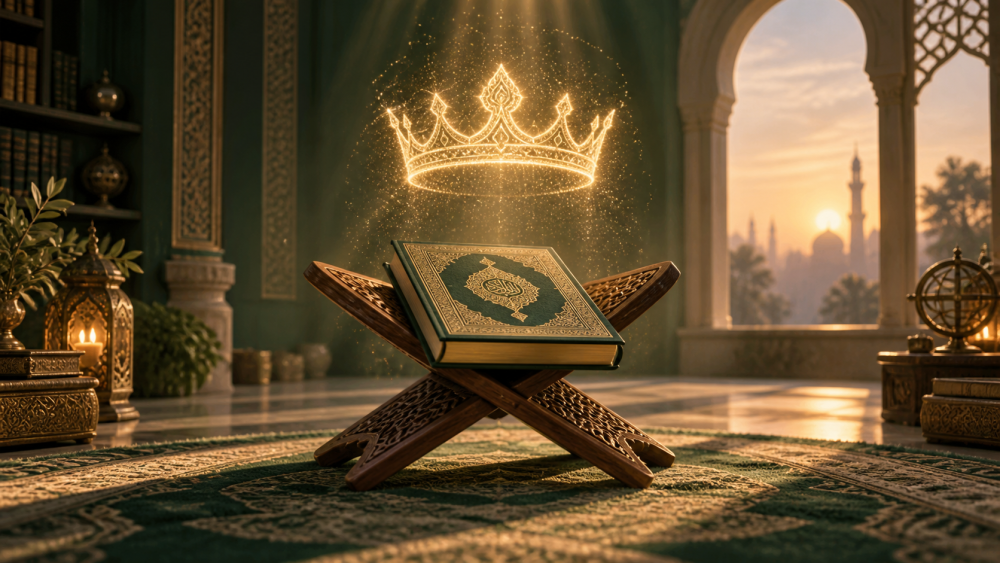
Tajulwaqar was not chosen merely because it sounds beautiful. The name expresses what we hope for every Quran student: knowledge that elevates, action that beautifies, and a noble influence that reaches the family.
We wanted a name for a Quran and Arabic learning platform that would unite light with responsibility, and honour with action. “Taj al-Waqar”—the Crown of Dignity—draws on narrations about the reward of the companion of the Quran. It reminds us that our relationship with the Quran does not end at recitation; it grows through learning, reflection, perseverance, and practice.
The Prophet ﷺ said regarding the companion of the Quran:
“A crown of dignity will be placed upon his head, and his parents will be clothed in two garments beyond worldly value.”
This wording appears within the hadith of Buraydah ibn al-Husayb al-Aslami (may Allah be pleased with him). What moved us was not the crown alone, but the path described around it: companionship with the Quran, patient recitation, learning, and action. We chose the name as an educational aspiration—not as a slogan detached from its meaning.
It is recorded by Imam Ahmad in the Musnad (22950), al-Darimi (3391), and al-Bazzar (4421) in an abridged form. Ibn Kathir described its chain as “hasan according to the standard of Muslim.” The Arabic text and detailed references are available in the Dorar Hadith Encyclopedia.
Another narration from Buraydah says that the person who recites, learns, and acts upon the Quran will be given “a crown of light.” Al-Hakim recorded it in al-Mustadrak (2086), and al-Albani graded it hasan li-ghayrihi in Sahih al-Targhib (1434). View the source and grading.
A popular summary says that a Quran memoriser’s parents will wear the Crown of Dignity. The wording that explicitly gives a crown to the parents is reported by Abu Dawud (1453) and Ahmad (15645). Al-Albani and Shu‘ayb al-Arna’ut considered its chain weak, while the editors of the Risalah edition of the Musnad considered it hasan li-ghayrihi. The stronger Buraydah narration places the Crown of Dignity on the companion of the Quran and mentions two magnificent garments for the parents. We therefore preserve the wording and identify the scholarly difference rather than presenting a disputed chain as unanimous.
Begin with sound recitation and a teacher who corrects pronunciation and tajweed with clarity and kindness.
Memorise what you can, understand vocabulary and context, and strengthen your reading through tajweed and Arabic grammar for Quran understanding.
Let what you recite shape prayer, honesty, mercy, and character. The narration itself does not separate the Quran’s honour from acting upon it.
The Prophet ﷺ said, “The best of you are those who learn the Quran and teach it.” This is recorded in Sahih al-Bukhari (5027). Tajulwaqar exists to connect sincere learners with teachers who strive to pass on the Quran with care and excellence.
No platform can guarantee a particular reward in the Hereafter for any individual, and a hadith should never be reduced to an empty advertising line. For us, Tajulwaqar is a reminder of hope and responsibility: learn the Quran sincerely, remain its companion, act upon its guidance, and ask Allah for acceptance.
The heart of the name: not only how many pages you memorise, but how you learn, persevere, and allow the Quran to shape your worship and character.
Yes. The phrase appears in the hadith of Buraydah recorded by Ahmad, al-Darimi, and others; Ibn Kathir graded its chain hasan according to the standard of Muslim.
The narrations speak of reciting, learning, taking up the Quran, and acting upon it. Memorisation is a great form of companionship, but it does not replace practice or an ongoing relationship with the Quran.
Because careful transmission of the Sunnah is part of respecting the message behind our name. We distinguish stronger narrations from those whose chains scholars assessed differently.
A sincere step, the right teacher, and steady consistency—this is where companionship with the Quran begins.
Explore Tajulwaqar Teachers